AI-powered code generation has been the biggest topic in the developer community lately. We've all tried GitHub Copilot, Cursor, and the likes, but Blitzy takes a radically different approach. Instead of assisting you line by line, it orchestrates over 3,000 AI agents that think, plan, and code for hours to deliver entire applications autonomously. Founded in 2023 at the Harvard Innovation Lab by Brian Elliott (CEO, former US Army Ranger, West Point + HBS grad) and Sid Pardeshi (CTO, ex-NVIDIA engineer with 7+ years and 27 patents in generative AI), this is not your typical AI coding tool.
I was really curious to explore what this "autonomous batch building" approach looks like. Let's dive in! 🚀
What immediately caught my attention about Blitzy is their "System 2" approach to AI code generation. While most AI coding tools operate in what you could call "System 1" mode (fast, reactive, generating code in seconds), Blitzy flips the script entirely 🤯.
The platform orchestrates over 3,000 specialized AI agents that collaborate for 8 to 12 hours on a single task. Think about that for a second: instead of getting a quick autocomplete suggestion, you're getting hours of deep reasoning and planning applied to your codebase. It's like the difference between a quick brainstorm and a full architecture review.
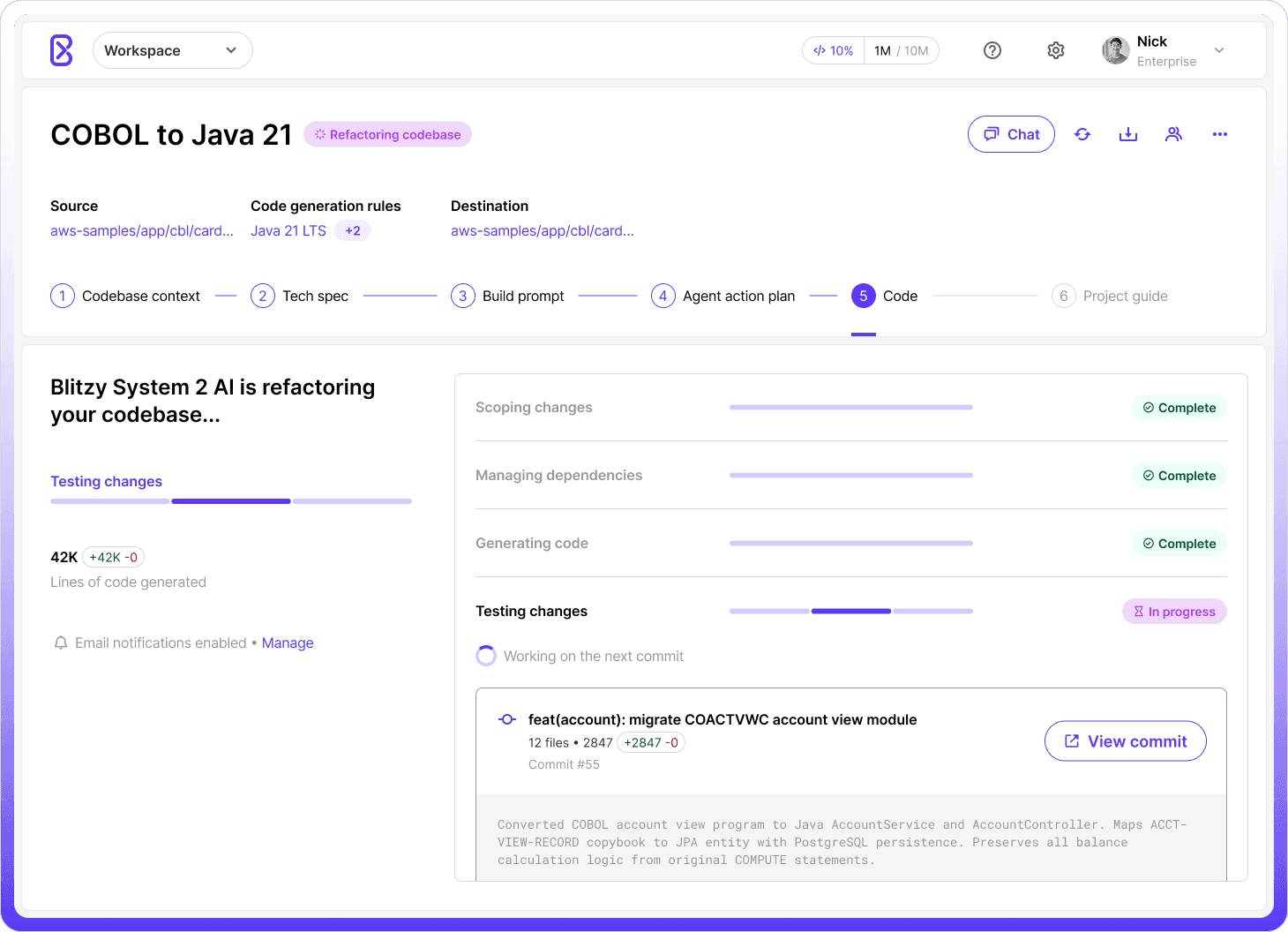
Example of a Blitzy generation
This approach recently earned them the #1 spot on SWE-bench Verified with an 86.8% score, ahead of EPAM AI + Claude 4 Sonnet (76.8%), ACoder (76.4%), and TRAE (75.2%). That's a massive 10 percentage point jump over the competition, the largest single advance on the benchmark since March 2024. Whether benchmarks tell the whole story is debatable, but those numbers are seriously impressive 😍.
The documentation itself recommends using Copilot for tasks that would take less than half a day. Blitzy is designed for the heavy, multi-day projects. I appreciate the honesty!
The way Blitzy operates is fundamentally different from copilot-style tools. The workflow follows a structured 6-step pipeline:
Codebase Onboarding: Blitzy ingests your entire codebase, mapping dependencies, packages, and libraries. It supports infinite code context, processing over 100 million lines in a single pass 😱
Tech Spec Generation: The AI generates a comprehensive technical specification documenting your architecture
Prompt Writing: You describe in natural language what you want to build or change
Agent Action Plan (AAP) Review: Blitzy produces a detailed implementation plan that you review and approve before any code is generated
Autonomous Code Generation: The 3,000+ agents get to work and can generate up to 3 million lines of code, pre-compiled and validated in isolated environments (from static analysis up to full end-to-end tests with databases and APIs!)
Project Guide Delivery: You receive documentation of what was built and what remains for your developers to finalize
The human-in-the-loop aspect is really well thought out. You review the plan before any code is generated, and the final 20% is left for your team. It integrates directly with GitHub, GitLab, and Azure DevOps, creating branches, pushing commits, and opening pull requests automatically. There's even a Figma integration for design-to-code conversion 🔥.
What I also love is the async nature: you launch a generation job and get notified when it's done. No need to sit and watch. You can focus on other work while Blitzy thinks for hours.
Blitzy covers a wide spectrum of enterprise development scenarios, and they back it up with concrete open-source case studies featuring real metrics 👀:
Development & Modernization:
COBOL to Java 21 migration: 23K lines, 87% completed autonomously, saving 380 hours of engineering time
The co-founders emphasize that Blitzy is "not meant to replace copilots, but enhance them." Engineers still use their preferred tools for the final polish. That's a smart positioning that makes it feel like a genuine teammate rather than a replacement 🙌🏻.
💡 One cool developer feature: there's a .blitzyignore file (similar to .gitignore) that lets you exclude specific files from generation. And you can actually chat with your entire codebase thanks to the infinite context, which is pretty wild when you think about repositories with millions of lines.
Security is clearly a first-class citizen here, and for enterprise clients this is non-negotiable 🛡️.
Blitzy is SOC 2 Type II compliant and ISO 27001 certified. But what's really impressive is the depth of their security posture:
No training on your code: only embeddings are stored
End-to-end encryption
Air-gapped code generation: your code is generated in an environment that's not publicly accessible
Inbound-only VPC architecture with no exposed endpoints
The deployment options are incredibly flexible: Cloud, Hybrid Cloud, VPC, Black-box VPC, On-prem, and even Black-box On-prem for organizations that need absolute control over their IP. If you're a bank, a defense contractor, or any org with strict data sovereignty requirements, they've got you covered 😎.
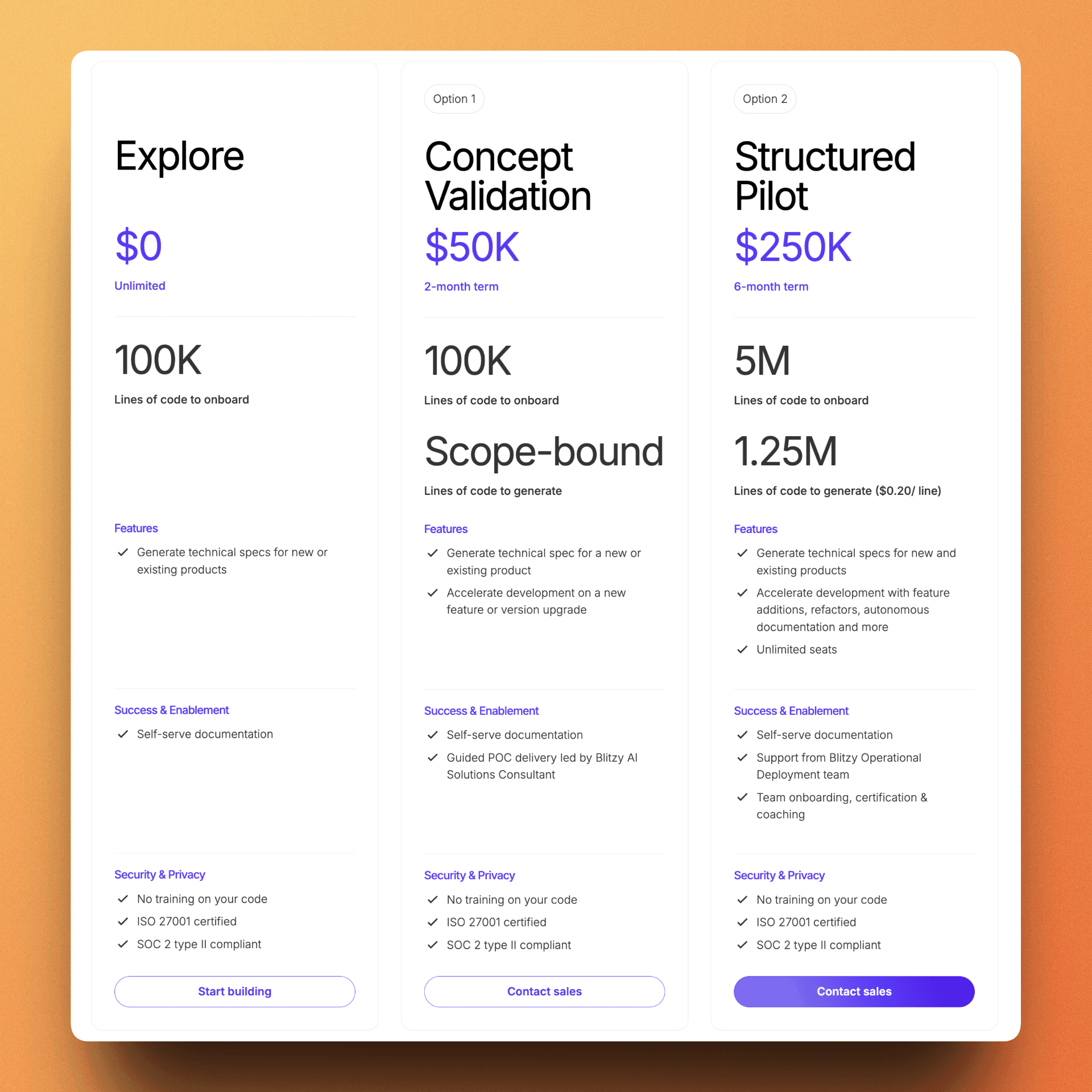
Here's where things get real, and where you'll see that Blitzy is firmly a large enterprise tool 👀. The pricing model works in two phases: evaluation then deployment, with a base rate of $0.20 per line generated.
Evaluation phase:
Explore: Free. 100K lines onboarded, Tech Spec generation only (no code). Perfect for kicking the tires
Concept Validation: $50K for 2 months, with a guided POC with the Blitzy team
Structured Pilot: $250K for 6 months. 5M lines to onboard, 1.25M lines to generate, unlimited seats, with a dedicated operational deployment team
Transformation: Starting at $10M+/year (48-month term). Infinite code context, custom deployment (client VPC or on-prem), and a Forward Deployed Engineering team embedded at your company
Blitzy pricing — from free exploration to enterprise transformation
I'll be completely honest: this is not a tool for indie developers or small startups 😅. But when you consider that a team of 10 senior engineers easily costs $2M+/year, and Blitzy claims to compress 6-month projects into 6-day turnarounds... the ROI math starts to make sense for organizations with massive, complex codebases. One caveat though: jobs are not cancellable once submitted, so they consume your quota regardless — something to keep in mind when planning your generations.
A quick shout-out to the documentation at docs.blitzy.com, which is genuinely well-structured 📚. It covers:
Getting Started with clear explanations of core concepts (ingestion, Tech Spec, AAP, Project Guide)
Blitzy Certified: a full certification program covering prompt engineering (with detailed "Golden Rules" in 10 principles), administration, and PR review processes
Template Library: structured prompt templates for every scenario: new products, features, refactoring, bug fixes, security, testing, documentation, and Figma-to-code
SDLC Integration: a detailed guide on how to integrate Blitzy into existing agile workflows with three predefined workflows (Sprint Acceleration, Parallel Large-Scale Projects, Code Quality Improvements)
The fact that they offer a certification program shows they're serious about helping teams get the most out of the platform. The prompt quality heavily influences the output, and they clearly invest in educating users on best practices 🙌🏻.
Blitzy represents a genuinely unique approach to AI-assisted development. While everyone else is building smarter copilots, Blitzy is building an autonomous software factory — and the technology behind it is seriously impressive.
What I loved:
🤯 System 2 AI approach - Hours of deep reasoning with 3,000+ agents, resulting in enterprise-grade code output
🏆 #1 on SWE-bench Verified - 86.8% score, 10 points ahead of the competition, the largest leap since 2024
🔥 Infinite code context - Ingests 100M+ lines, meaning it truly understands your entire codebase with zero blind spots
🛡️ Enterprise security - SOC 2 Type II, ISO 27001, air-gapped generation, and flexible deployment from cloud to on-prem
📚 Excellent documentation - Certification program, prompt templates, SDLC integration guides. They invest in user success
🔗 Smart integrations - GitHub, GitLab, Azure DevOps, and Figma with automatic PR creation
Points to consider:
💰 Enterprise-only pricing - The entry point for code generation is $50K (POC), scaling to $500K+/year for deployment. Clearly not for small teams
⏱️ Non-cancellable jobs - Once submitted, generations consume your quota even if you realize you need to change something
📝 Prompt-dependent quality - The output heavily relies on prompt quality, which means a learning curve even with their templates and certification
If you're an engineering leader at a large organization dealing with millions of lines of code, legacy modernization, or aggressive development timelines, Blitzy is absolutely worth evaluating. The free Explore tier lets you generate a Tech Spec to see how it understands your codebase — start there. For the right team and the right project, this could genuinely compress months of work into days 🚀!
Get your own Review
Do you want us to review your product? Click here to get started!
Superblog Review - A Blogging Platform Built for Google and ChatGPT
We've tested Superblog, a hosted blogging platform for SaaS teams that handles technical SEO, AI search, subdirectory hosting and built-in auto-translation, with an MCP server for AI agents.
Reviews
MakeForms Review - A HIPAA Form Builder That Also Signs and Schedules
We've tested MakeForms, a HIPAA-ready form builder that bundles OTP verification, per-region data storage, e-signatures, document generation and scheduling.
Reviews
DOER Review - A Network With No Algorithm, Zero Commission
We've tested DOER, a professional networking platform with no ads, no algorithm and zero commission, where members connect, learn, earn as mentors and build in public.
Reviews
HTML/CSS to Image Review - URL Screenshots, Social Cards and MCP
We've tested HTML/CSS to Image, a rendering API for HTML, live URLs and reusable templates, now with a visual editor and a hosted MCP server.
We use cookies
Essential and analytics cookies keep Uneed running and help us understand usage. Marketing and affiliate cookies are optional. Privacy policy