Online fraud is one of those things every developer knows they should handle better, but it always ends up at the bottom of the backlog. Fake signups, disposable emails, bots abusing your free tier, suspicious IPs... we've all been there. At Uneed, we've been dealing with this problem for a while.
We started building some validation logic, then realized we needed to maintain blocklists, check for VPNs, verify email deliverability... and suddenly our "quick fix" has become a full project, impossible to maintain.
That's exactly the problem Veille tackles. It's a set of fraud detection APIs that let you validate emails, domains, IPs, IBANs, VAT numbers, and more, all through simple REST endpoints with blazing fast response times. Let's see what it has to offer! 🚀
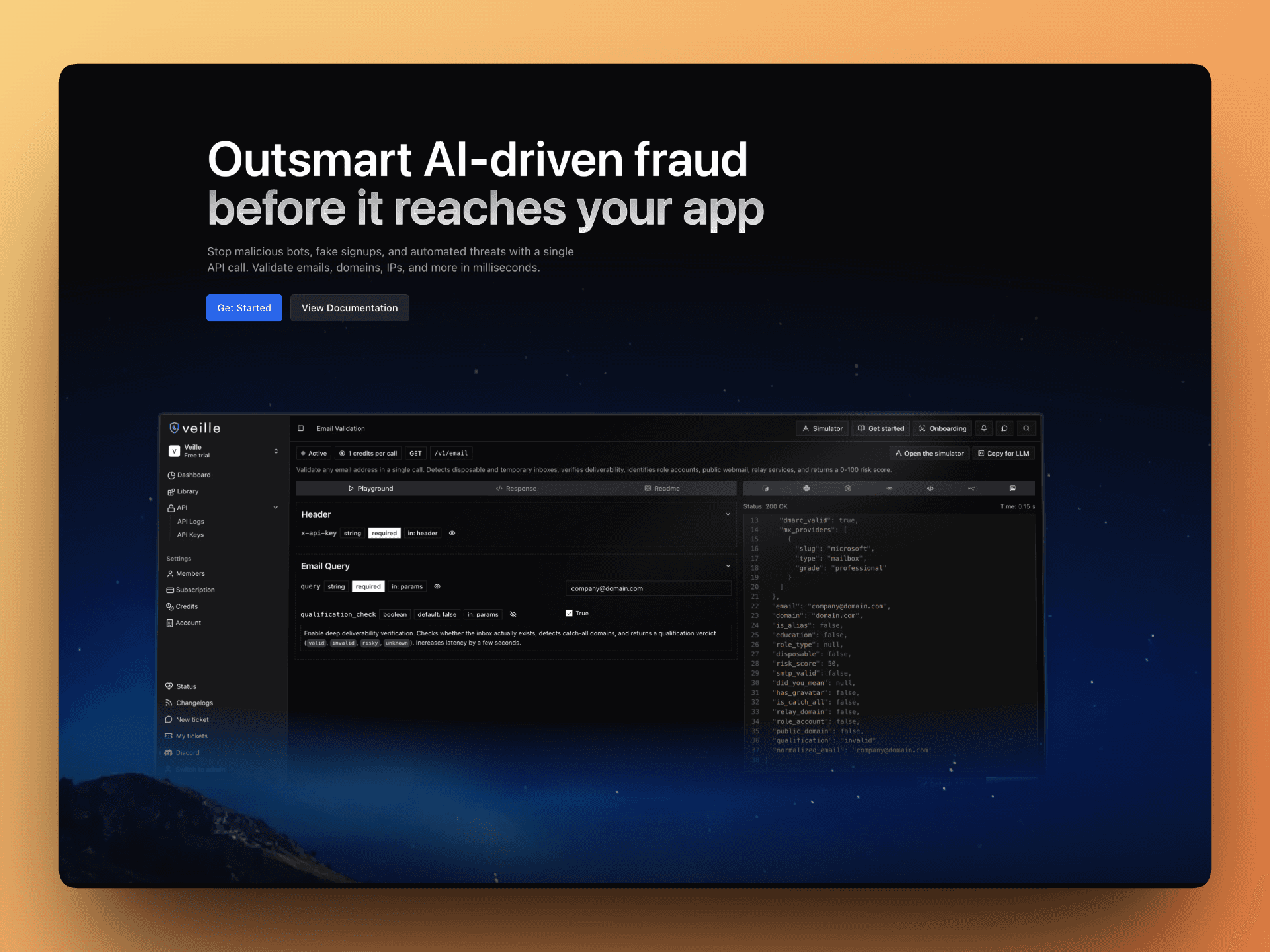
The first thing I noticed about Veille's website is how developer-focused it is. No flashy marketing jargon, no stock photos of people in suits shaking hands. Just a clean, dark-themed landing page that gets straight to the point: fraud detection APIs for developers who move fast 😎.
Also, the hero's image looks good, I like the interface 👀.
Getting started is simple:
Sign up and create an account
Grab your API key from the dashboard
Make your first request
You get 1,000 free credits on the free trial, which is more than enough to properly test all the endpoints. Each API call costs exactly 1 credit - no complicated credit multipliers to figure out. I love the transparency here 🙌🏻
The authentication is straightforward too - just pass your API key in the x-api-key header and you're good to go. No OAuth flows, no token refreshes. Simple.
So simple that I really want to try it out on Uneed actually!!
I didn't just want to review Veille from the docs. I wanted to actually use it. So I decided to integrate the email validation endpoint directly into Uneed's signup flow 💪!
The goal is simple: when a new user signs up on Uneed, we call Veille's email validation API to check if the email is disposable, temporary, or flagged as spam. If it is, we block the signup and ask the user to use a real email address.
Why? Because disposable emails are a real pain for us 😅. People create 10 accounts with throwaway addresses, upvote their product, and disappear. It pollutes our database, messes with our metrics, and it's really unfair to the users who are competing fair and square.
So, let's go!!
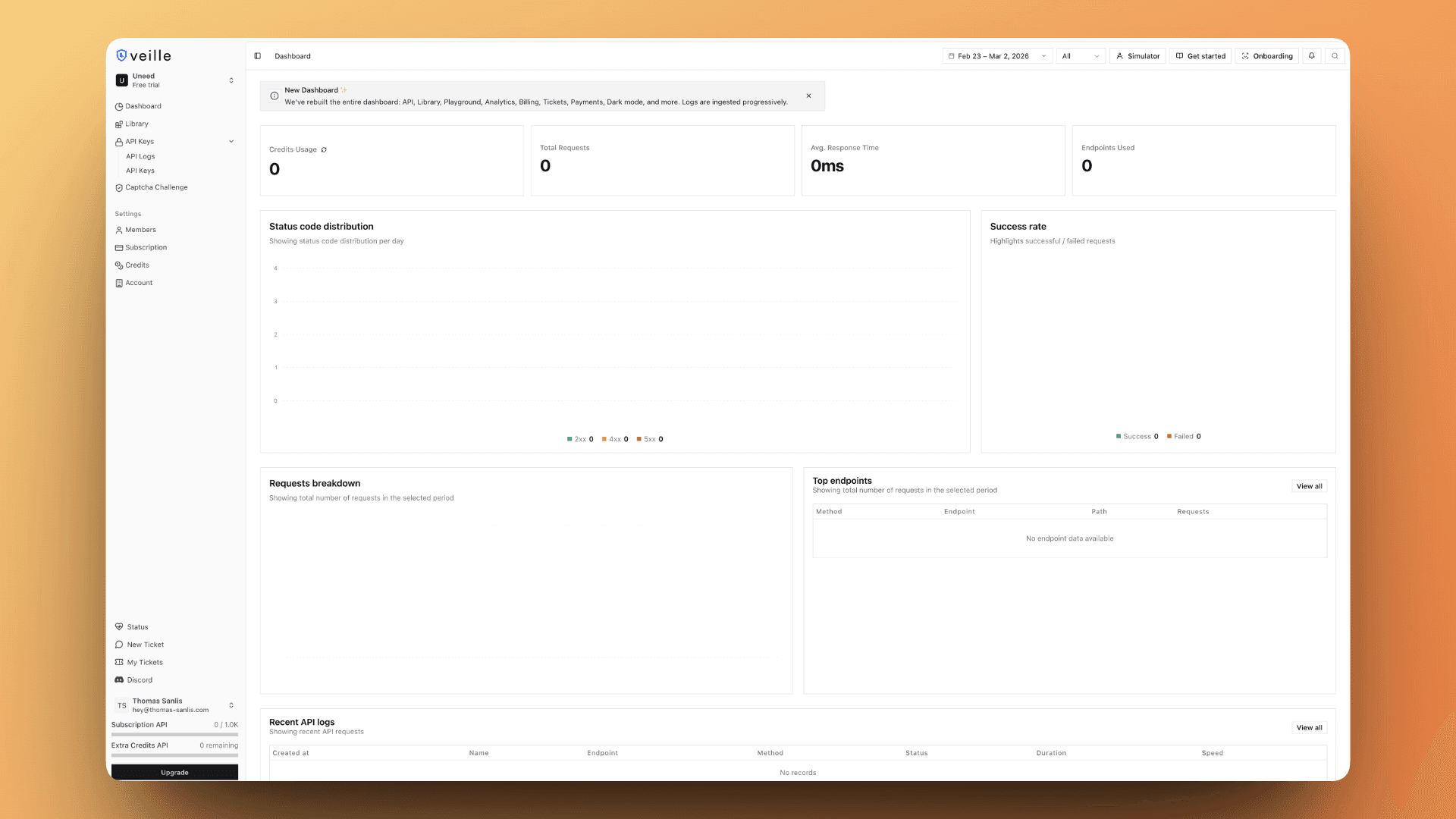
First thing I do: open the dashboard to see what we're working with. Of course, it's pretty empty, as you can expect.
Veille's dashboard
But do you notice the "Library" tab on the left sidebar? That's where things get interesting 👀.
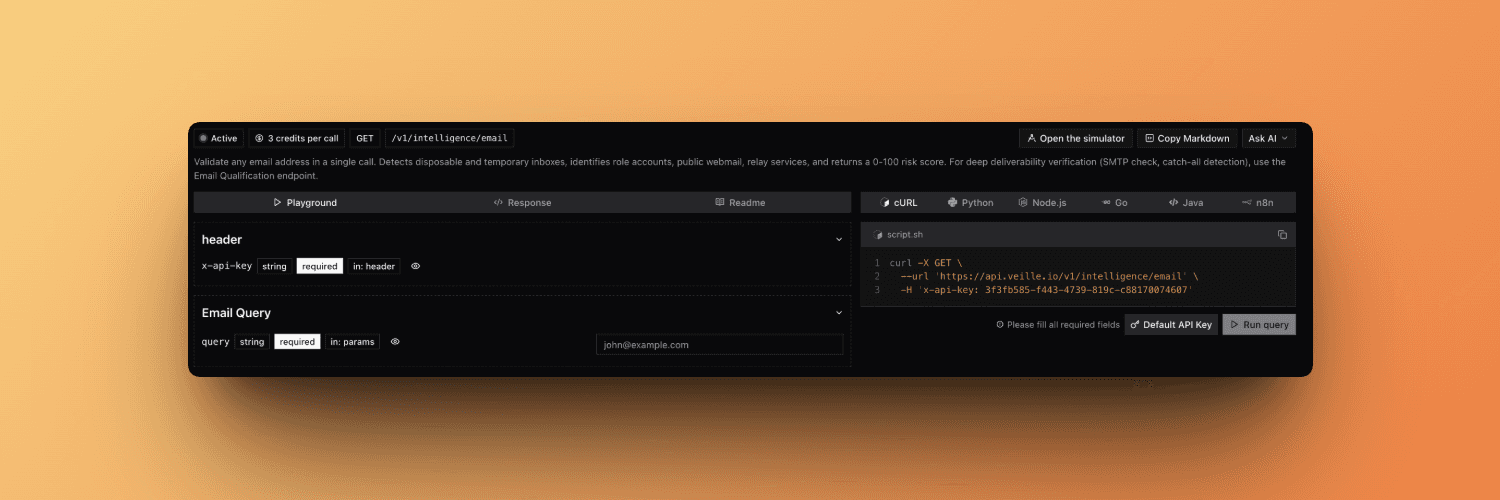
This is where all the magic happens. The Library gives you access to every single endpoint Veille offers, and you can test them all directly from the browser. No need to open Postman or write a cURL command. You just fill in the parameters, hit send, and see the full JSON response right there. Before writing a single line of integration code, I can already play around with everything Veille has to offer 🧪
Testing the email validation endpoint
But before jumping into the email validation integration, let me take you through what's available. Because Veille is much more than just an email checker.
The endpoint that interests us most is email validation: deliverability check, disposable email detection (380,000+ domains tracked, updated daily 🤯), a 0-100 risk score, and domain intelligence. There's also a dedicated domain validation endpoint for DNS records, WHOIS data, and security config.
But Veille goes way beyond email. IP intelligence detects VPNs, proxies, and Tor exit nodes with the same 0-100 risk scoring, all in sub-50ms. And for European SaaS companies, there are financial validation endpoints: IBAN validation, VAT number verification against the EU VIES database, and exchange rates for 30+ currencies. One key, one dashboard, everything under one roof 👏
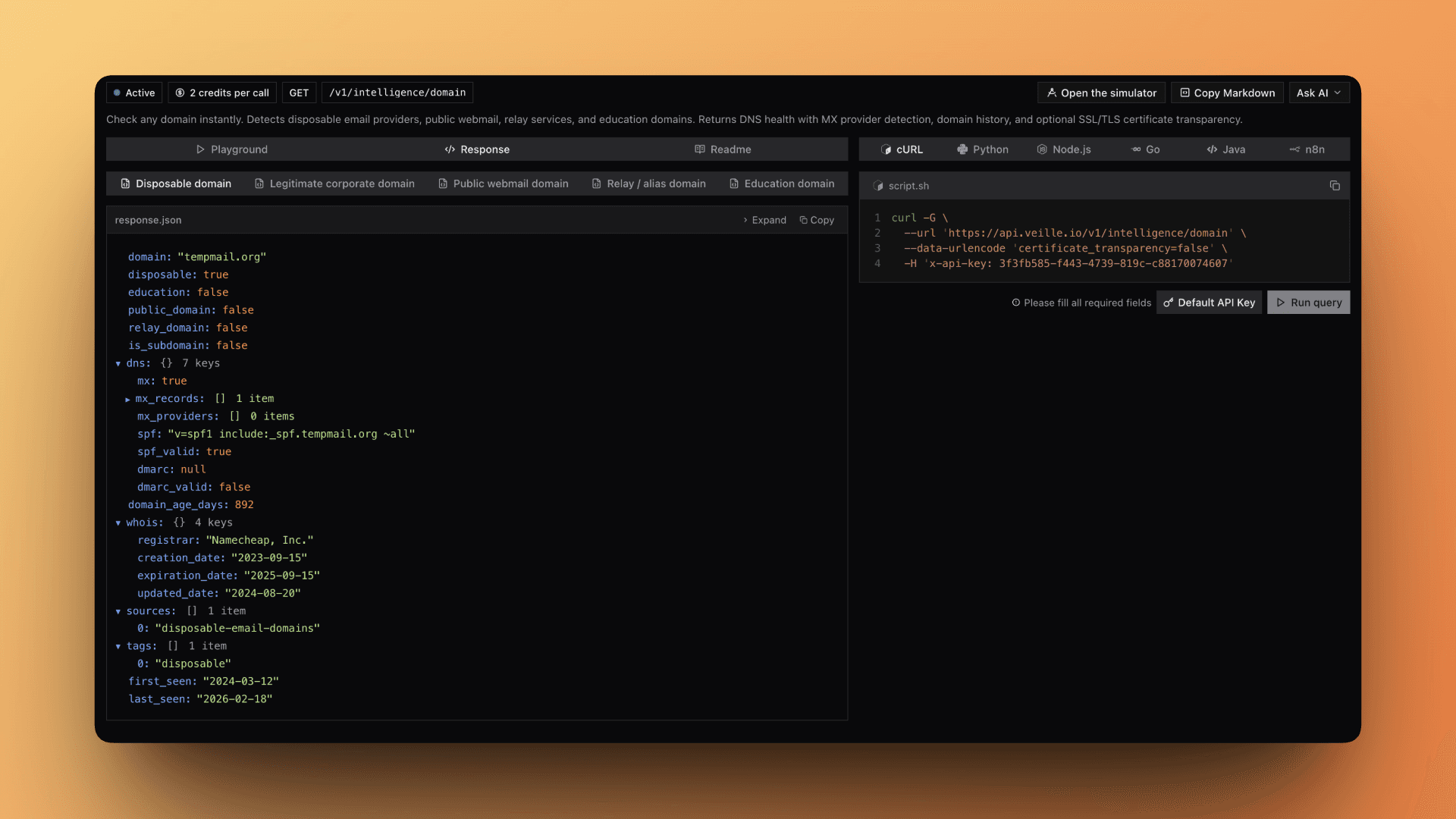
Quick note on the docs: it's integrated into the library, for each endpoint:
Documentation for the email validation endpoint
You can easily grab the code to use the endpoint in your own project, in your terminal and even on n8n!
Last bonus: a README is integrated into each endpoint 😭. TLDR; the docs are just perfect.
OK, enough exploring. Let's actually build this thing!
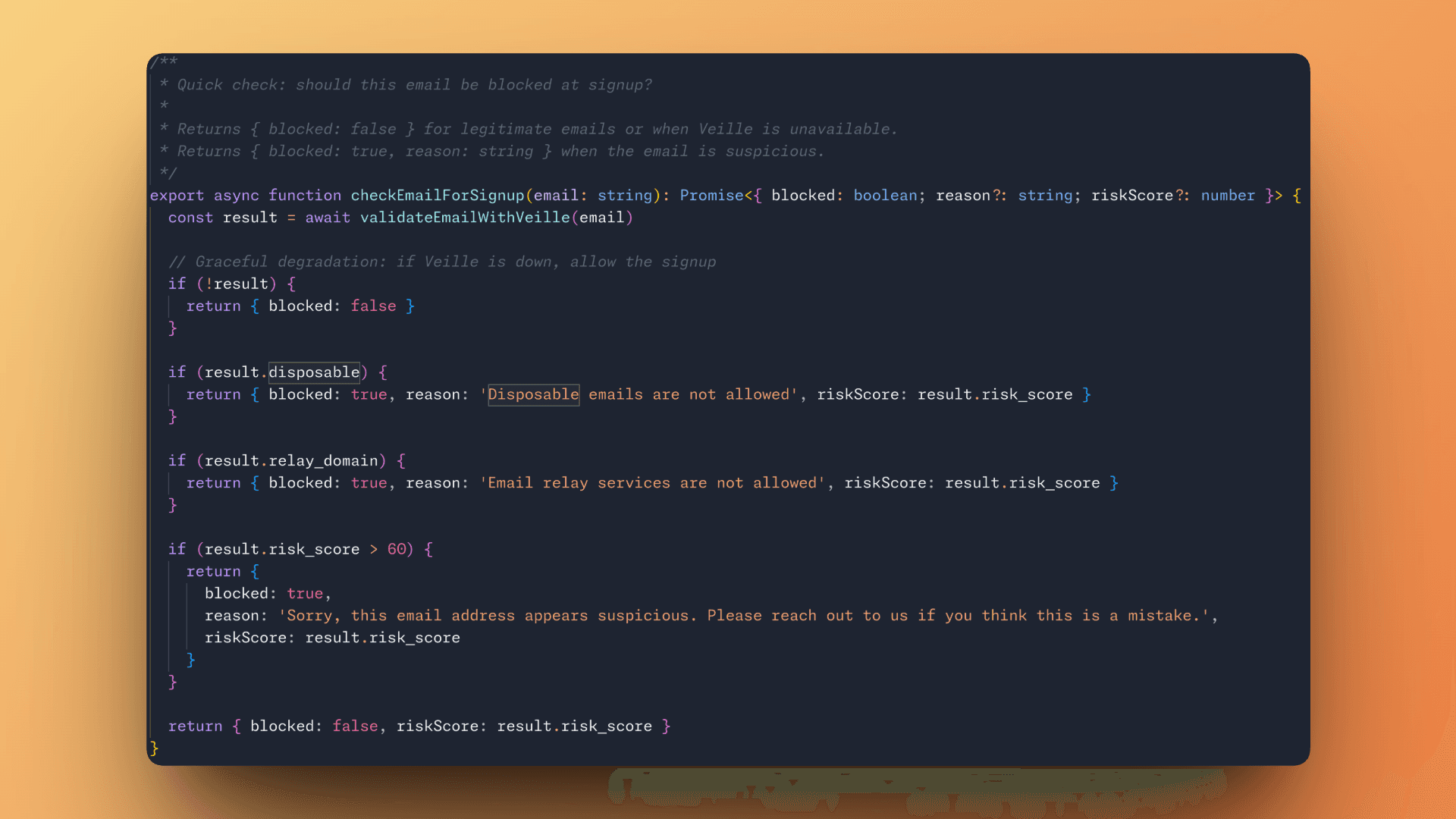
The integration itself is straightforward. On signup, we send the email to Veille's /v1/email/validate endpoint. The response comes back with a clear risk score and a disposable boolean. If the email is flagged as disposable or the risk score is too high, we reject the signup with a friendly error message asking the user to use a permanent email address.
Here's the exact code we use in Uneed's signup flow:
export async function checkEmailForSignup(email: string): Promise<{ blocked: boolean; reason?: string; riskScore?: number }> {
  // validate the email with Veille
  const result = await validateEmailWithVeille(email)

  // if Veille is down, allow the signup
  if (!result) {
    return { blocked: false }
  }

  if (result.disposable) {
    return { blocked: true, reason: 'Disposable emails are not allowed', riskScore: result.risk_score }
  }

  if (result.relay_domain) {
    return { blocked: true, reason: 'Email relay services are not allowed', riskScore: result.risk_score }
  }

  if (result.risk_score > 60) {
    return {
      blocked: true,
      reason: 'Sorry, this email address appears suspicious. Please reach out to us if you think this is a mistake.',
      riskScore: result.risk_score
    }
  }

  return { blocked: false, riskScore: result.risk_score }
}
We're excited to see how this impacts our spam and fake account numbers over the coming weeks. If it works as well as our initial tests suggest, this could save us a lot of cleanup work 🎉
Advanced: 499 EUR/month, 3,500,000 credits, 100 req/s, 1-year data retention
Every API call costs exactly 1 credit, no matter which endpoint. That's the kind of predictable pricing developers love 😍
The free tier with 1,000 credits is generous enough for thorough testing, and the Pro plan at 99 EUR/month with 500,000 credits should cover most growing SaaS applications. The 99.9% uptime SLA across all plans is reassuring too.
Veille is a well-crafted, developer-first fraud detection API that packs a lot of value into a clean, simple interface. It's clear that they've put serious engineering effort into building something that actually solves real problems for developers dealing with fraud, bots, and fake accounts.
What I loved:
🚀 Blazing fast response times: Sub-50ms latency means you can use it inline without slowing down your UX
🔍 380K+ disposable email database: Updated daily, this is one of the most comprehensive I've seen
🎯 All-in-one API: Email, domain, IP, IBAN, VAT, and exchange rates under a single auth and billing system
💰 Transparent pricing: 1 credit = 1 API call, no hidden fees, no gotchas
🛡️ Financial validation endpoints: IBAN and VAT verification is a killer feature for European SaaS companies
Points to consider:
The dashboard currently lacks analytics widgets that would let you visualize your request history by risk score, which would be really interesting for our use case. Buuut I talked to the founder, and he told me it's coming soon!
🔄 UPDATE: Well 😂... Remember how I just said the dashboard lacked analytics? Turns out they already shipped the Insights feature before I could even publish this review!
The new Insights page with fraud detection analytics
On this page, you can find all sorts of useful data, but the one that really caught my eye is this: the number of suspicious accounts we tracked in the last 24 hours. And surprise: 9.3% of them were disposable emails, and 2 of them presented a high risk! That's exactly the kind of visibility I was asking for, and it's already live. They moves fast 🏎️
Anyway, if you're a developer building signup flows, checkout processes, or any user-facing form that needs fraud protection, Veille deserves a serious look. The combination of speed, accuracy, and breadth of coverage makes it a strong contender in the fraud detection space. And with the free trial giving you 1,000 credits to test everything, there's no reason not to try it out 🚀
BlogSEO Review - SEO Automation That Writes, Benchmarks and Builds Links
We've tested BlogSEO, an SEO automation tool that researches keywords, writes and publishes blog articles, trades backlinks through a non-reciprocal network and lets Claude or ChatGPT run it over MCP.
Reviews
ScreenKite Review - The Mac Screen Recorder Your AI Agent Can Edit
We've tested ScreenKite, a native Mac screen recorder and video editor that hands its timeline to your own AI agent, with auto zoom, 3D device mockups and on-device captions.
Reviews
Superblog Review - A Blogging Platform Built for Google and ChatGPT
We've tested Superblog, a hosted blogging platform for SaaS teams that handles technical SEO, AI search, subdirectory hosting and built-in auto-translation, with an MCP server for AI agents.
Reviews
MakeForms Review - A HIPAA Form Builder That Also Signs and Schedules
We've tested MakeForms, a HIPAA-ready form builder that bundles OTP verification, per-region data storage, e-signatures, document generation and scheduling.
We use cookies
Essential and analytics cookies keep Uneed running and help us understand usage. Marketing and affiliate cookies are optional. Privacy policy