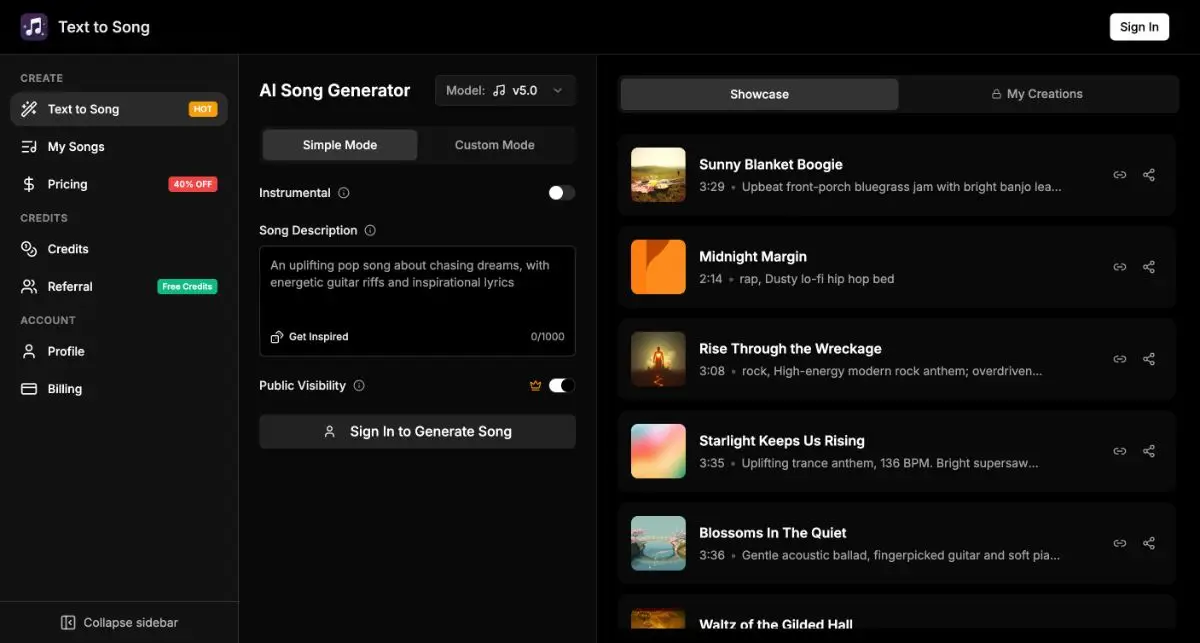
Text to Song is an online AI music studio that transforms any written text into a complete vocal song within minutes. It abstracts away complex music production so anyone can turn ideas, stories, or lyrics into polished tracks without instruments, recording gear, or prior experience.
It takes a simple text input—such as a sentence, a poem, script dialogue, or full lyrics—and automatically composes a melody, arranges accompaniment, and renders a human‑like singing voice on top of a professionally mixed instrumental. The service is built around a browser‑based workflow, so users can create songs end‑to‑end directly in their web browser without installing software or managing project files. By combining modern generative models for language, music, and voice, it interprets the meaning, rhythm, and emotional tone of the text and turns that into suitable tempo, harmony, and vocal performance. The platform is designed for both casual creators who want a quick musical idea and professionals who need fast, consistent song generation at scale. Output files can be downloaded and integrated into videos, games, podcasts, social media content, or personal archives.
The features of Text to Song are designed to streamline the entire songwriting and production pipeline into a simple, text‑first experience. The interface centers around a single text box where users can paste lyrics or describe the mood and style they want, while the system handles the technical decisions behind the scenes. It generates both the instrumental arrangement and the main vocal performance at the same time, so users do not need separate tools for backing tracks and singing. Multiple musical styles and moods are available, allowing users to tilt the output toward pop, ballad, hip‑hop, electronic, cinematic, or other directions depending on their project. The vocal delivery is sensitive to sentiment in the text, so sad or reflective content tends to produce softer phrasing, while upbeat or energetic lines are performed with more intensity. Since the service is web‑based, it is accessible on common devices, and users can quickly iterate by tweaking their text or style choices and regenerating until they reach a version that fits their needs.
The use cases for AI Song Generator span content creation, education, entertainment, and professional workflows. Video makers and social media creators can turn scripts, taglines, or story ideas into custom songs that better match specific scenes or campaigns than generic stock music. Songwriters and music producers can treat it as a fast sketchpad: they can hear how draft lyrics might sound when sung and explore alternative arrangements or genres before committing to a full studio production. Educators can transform poems, lessons, or student writings into songs to make classes more engaging and to demonstrate how language and music interact. For personal projects, users can create unique songs for birthdays, weddings, anniversaries, or other special occasions by feeding personal stories and messages into the system. In all of these situations, Text to Song reduces the friction between having an idea and hearing it as a complete song, making music creation more accessible to both professionals and beginners.