Project Context
Pulse was built around a simple constraint: keep application diagnostics local.
Many monitoring products assume an external collector, a hosted dashboard, or another service to operate. Pulse takes the opposite direction. It attaches directly to the JVM as a -javaagent, starts with the application, collects useful telemetry, and exposes everything through a local web UI.
The result is a lightweight APM workflow designed for developers and teams who want visibility without adding a full observability platform.
What Pulse Collects
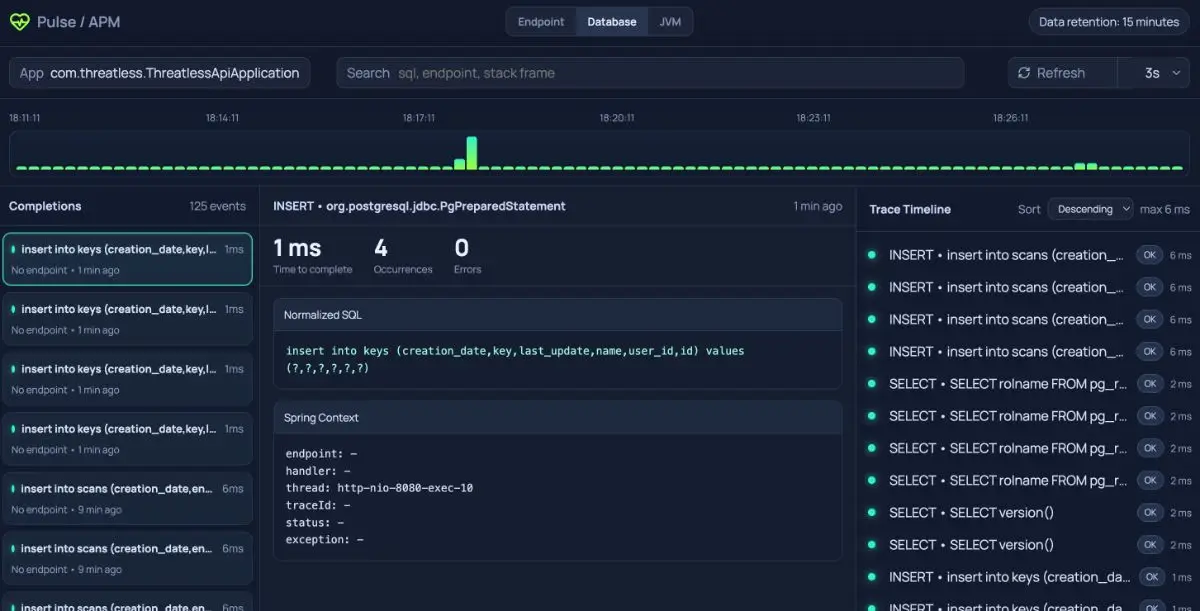
SQL activity
JDBC query instrumentation for
StatementandPreparedStatementquery duration, errors, and SQL operation type
Spring context enrichment
SQL to HTTP correlation through
traceIdor thread/time fallback
HTTP activity
endpoint transactions with method and path
status code, latency, and error tracking
sampled hotspots and call-stack visibility
request metadata with masking and sensitive filtering
JVM metrics
heap usage
process CPU
threads and garbage collection activity
average HTTP latency and p95 indicators
Operating Model
Pulse is designed to stay simple in production-like environments:
no external collector
no additional database
no mandatory cloud dependency
a single agent JAR started with the target JVM
That makes it useful for local debugging, offline analysis, staging validation, and self-hosted environments where telemetry should not leave the machine.
Launch Model
The integration model is intentionally small:
Copy
java \
  -javaagent:/path/to/pulse/target/pulse-1.0.0-agent.jar=port=17321 \
  -jar /path/to/your-app.jar
Once the application starts, Pulse exposes a local UI and API on the configured port.
Why This Project Matters
Pulse is not trying to replace a full enterprise observability stack. Its value is elsewhere:
immediate visibility with minimal setup
easier diagnostics for Spring Boot applications
better control over sensitive HTTP and SQL metadata
offline-first operation for restricted environments
This makes it a strong fit for teams that want a practical troubleshooting layer before introducing heavier infrastructure.
Current Direction
The project is focused on keeping the runtime small while improving the quality of collected insights:
better correlation between HTTP requests and SQL execution
clearer hotspot and call-stack views
stable JVM-level metrics for day-to-day diagnostics
a local UI simple enough to use without onboarding overhead
External Links
Live product: pulse.briacd.com
Repository: github.com/briacdev/pulse